What happens after you upload a photo
A person opens your files and checks each face. Your family is turned into character reference sheets, which are checked before anything is illustrated. Then the pages are drawn one at a time and checked against a written list of known failure modes. Your photos are deleted two days after the book ships.
You upload three photos and two names. About two weeks later a hardcover book arrives with your child on the cover, riding out to meet a dragon who, it turns out, is mostly cold. Every reasonable worry about this product lives in the gap between those two sentences.
So here is what happens inside the gap, including the parts that go wrong.
First a person looks at your photos
Before anything is drawn, a human opens the files you sent and asks three questions. Is each face sharp. Is each face big enough in the frame. Can you tell who is who across the photos.
This sounds like a formality. It is the single most expensive checkpoint in the whole process, because of the arithmetic: a bad photo caught here costs one email. The same photo caught at page fourteen costs a finished book and your delivery date. So we would rather write to you on day one and ask for a different picture than quietly illustrate around a blurry face and hope.
The three we send back most often are sunglasses, motion blur, and a photo where the child is a wonderful but very small figure in a very large meadow.
Your family becomes a reference sheet
The next step is the one nobody expects, and it is the reason the book holds together.
We do not paste your photo into a scene. We build a character sheet for each person: a single reference image that fixes how that hero is drawn — the face, the hair, the build, the proportions. Alongside it goes a wardrobe strip, which settles what everyone is wearing.
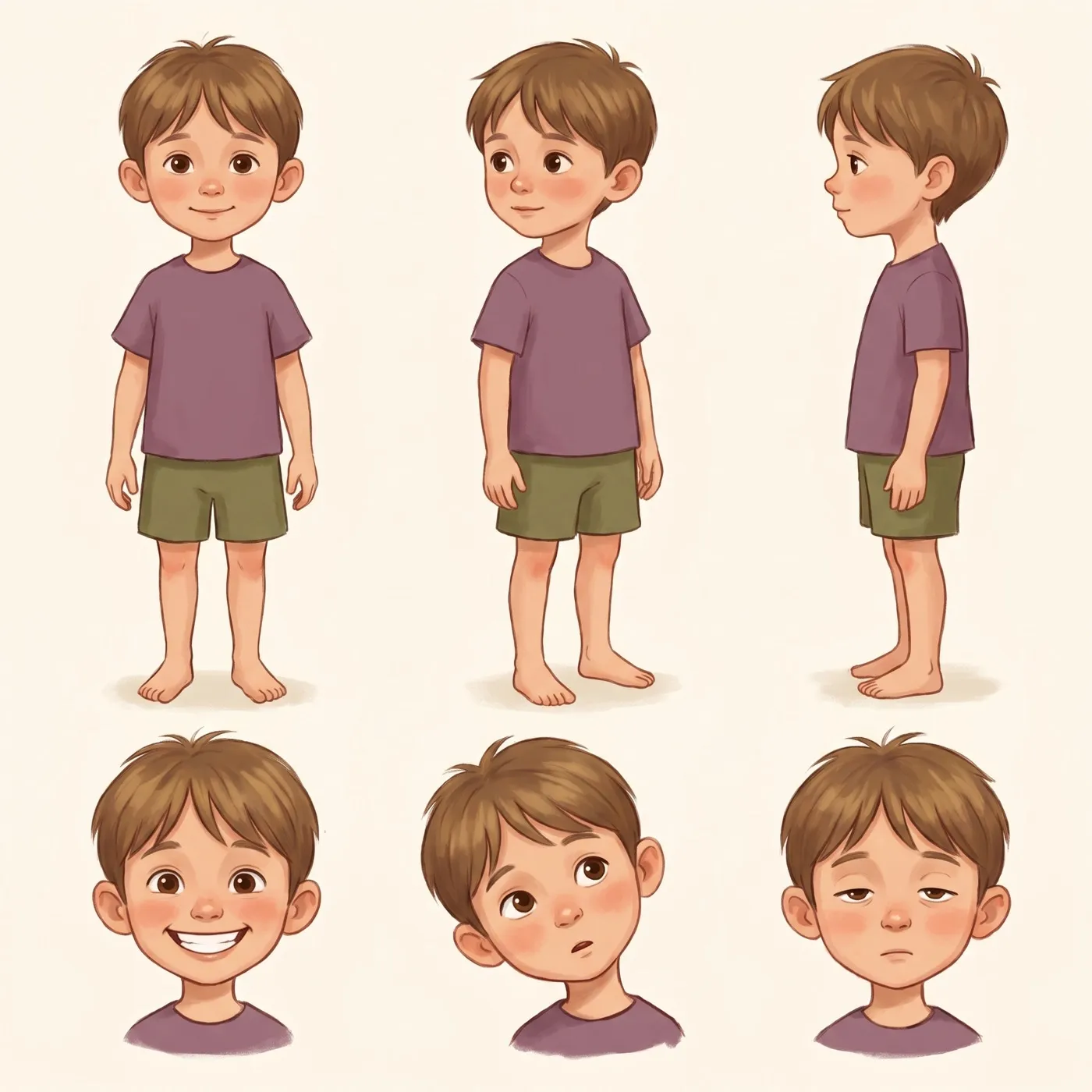
Then we do the same thing for the dragon.
The dragon has never been photographed. That is exactly the point. A character sheet is not really about likeness — it is about consistency. Without a sheet, a dragon is a slightly different dragon on every page: a horn migrates, the snout shortens, the wings change color. Children notice this immediately and adults notice it about four pages later. Anyone who appears more than once gets a sheet, including the dog.
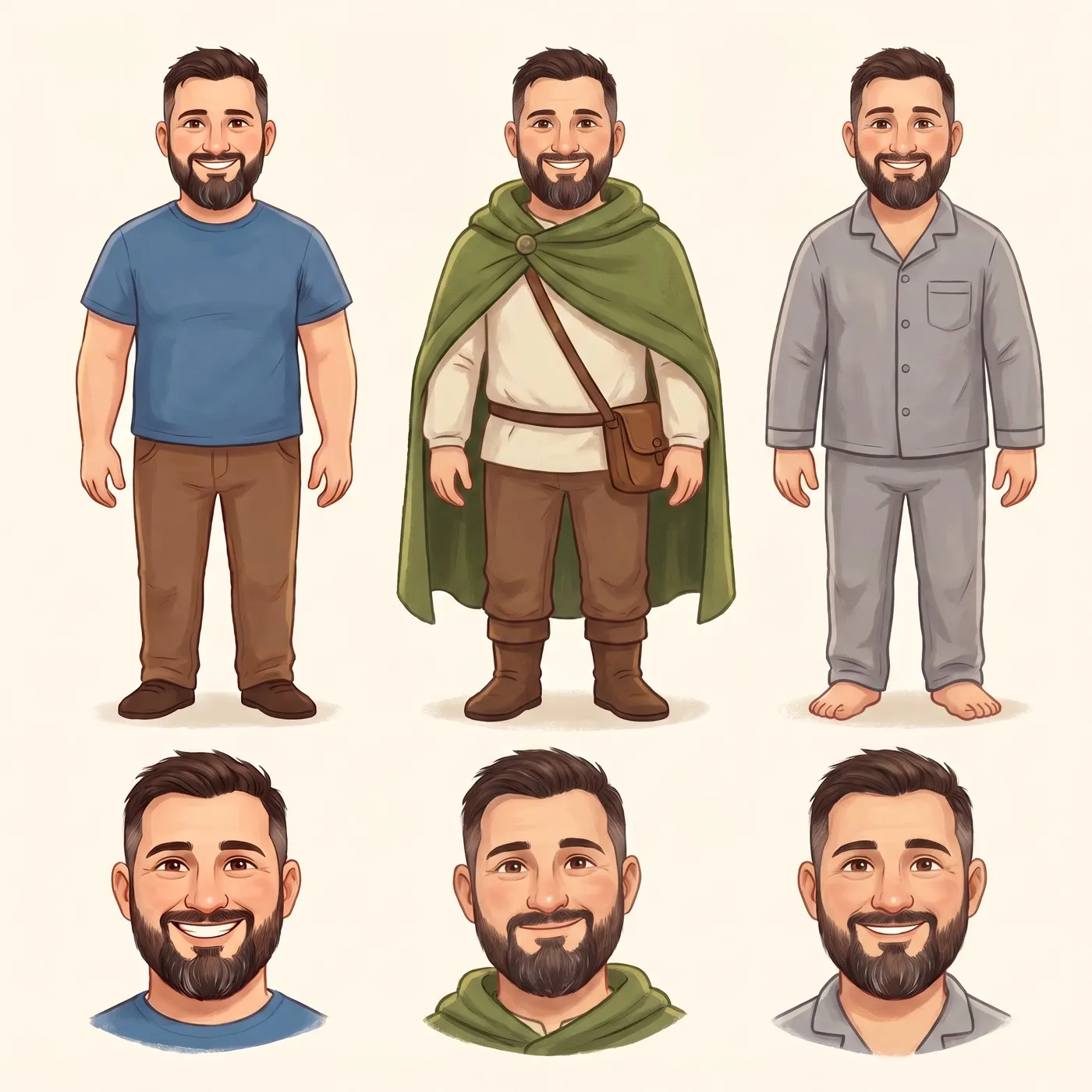
Nothing is illustrated until the sheets are signed off
There is a hard stop here. No page is generated until a person has looked at every character sheet, the wardrobe, and two or three style options, and approved them.
It is a deliberately boring gate, and it exists because this is the cheapest place in the entire process for a mistake to die. A wrong decision caught at the sheet stage costs a handful of images. The same wrong decision caught after the pages are made costs the whole run.
Then the pages, one at a time
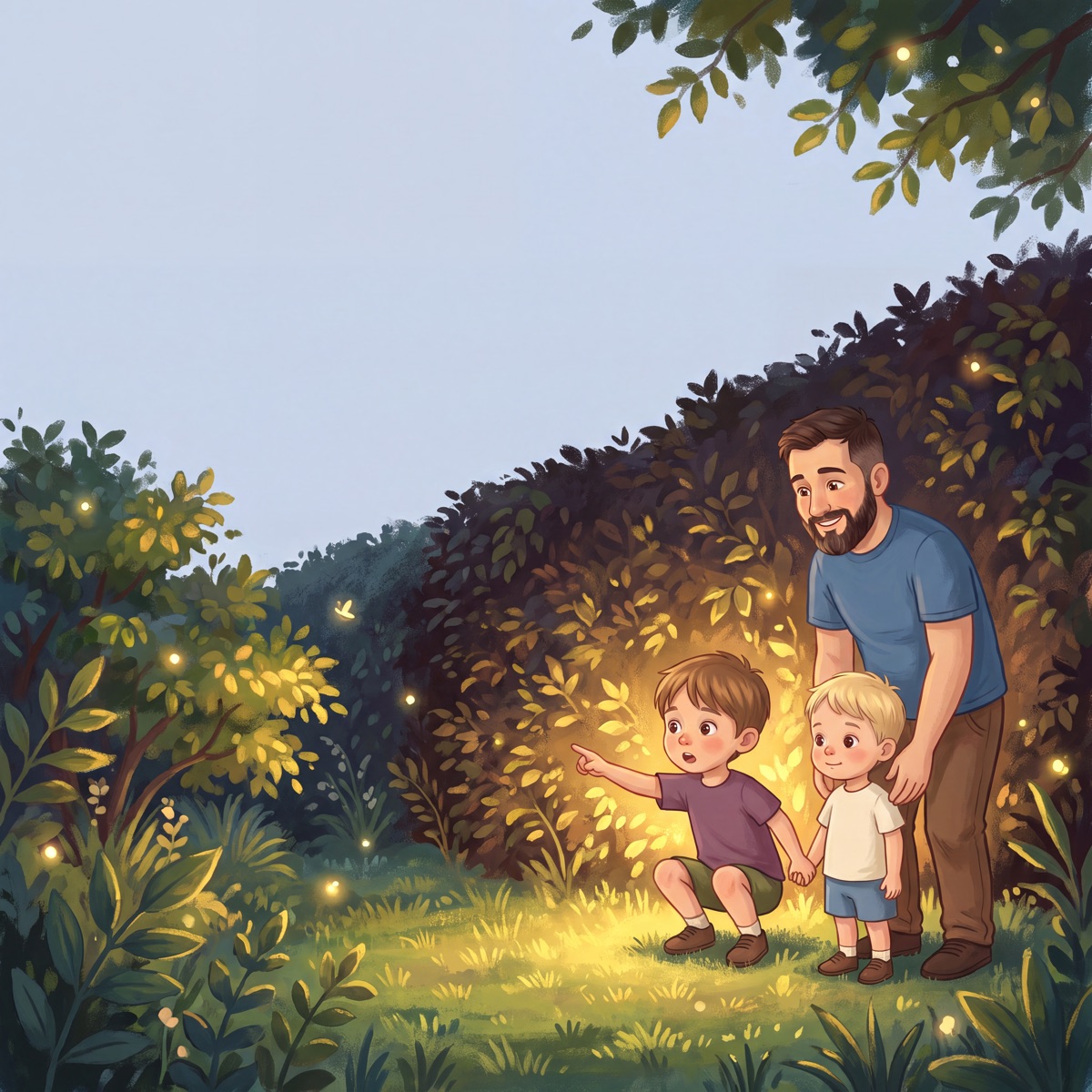
Twenty-four pages, nineteen original illustrations. Each page is made individually, with every character sheet handed to the illustrator as reference, so page nineteen and page three are looking at the same child.
Every page instruction also states the cast out loud — exactly three people and exactly one dragon, no duplicates. Writing that down feels absurd until you skip it once and a second toddler wanders calmly into the kitchen scene.
We keep a list of the ways this goes wrong
Illustration at this length fails in specific, repeatable ways, and pretending otherwise would be silly. So we keep the list and check every book against it:
- Style drift — page two and page twenty look like different books.
- The same outfit forever — including, memorably, asleep in bed.
- Props that exist only in the text — the words promise a lantern the picture never got.
- Hands and limbs that dissolve — a foot that becomes an idea of a foot.
None of these are mysterious. They are just what happens if nobody is checking, so somebody checks.
Yes, AI is involved. Here is exactly where.
We would rather be precise about this than coy, because "handcrafted" is doing a lot of quiet lying across this whole industry.
A person writes the story. The manuscript, what happens on each page, the names, the jokes, the ending — written and edited by a human being, in English, for a child aged four to ten.
The illustrations are made with AI assistance, in Kindlevale's own style, working from the character sheets described above.
A person reviews and approves every page against that failure list before anything reaches you.
Then a person reviews it. Every page is checked before it goes to print, and nothing goes to the printer until it has passed that check.
What we do not do is generate twenty-four images, staple them together, and call it a book.
Your photos leave when the book does
Two days after your book ships, the photos and the character sheets built from them are deleted. Not "when we get around to it" — a job runs every day and removes them, and it records that it did.
The order record itself stays, because tax law requires us to keep transaction records. Your children's faces are not a transaction record. The full timetable is written out in our Retention Schedule.
What you actually get
A printed hardcover on thick durable paper, 24 pages, 19 original illustrations, with the digital PDF included — $59.99 plus $9.99 US shipping. Digital only is $19.99. Printed and shipped in the USA, on your shelf in about two weeks.
And a dragon who is, for reasons the story explains, extremely cold.
Frequently asked questions
Will the heroes really look like my family?
They will read as your family in a storybook, not as a photograph of your family. The character sheets carry the things a child recognizes first — hair, face shape, build, the gap in the front teeth — and the illustration style does the rest. This is also why we check your photos first: a face that is too small, too dark, or behind sunglasses cannot carry a character.
How many photos do you need, and what makes a good one?
One to three, at least 1000 pixels on the short edge, up to 10 MB each. Good means faces sharp, faces reasonably large in the frame, and easy to tell who is who. Sunglasses, motion blur and a face the size of a thumbnail are the three we send back.
Is the story written by a person?
Yes. A person writes the manuscript, decides what happens on each page, and edits every line before anything is illustrated. The illustrations are made with AI assistance, and a person reviews and approves each one.
What happens to our photos afterwards?
They are deleted automatically two days after your book ships, by a job that runs every day. The order record stays because tax law requires it; the photos do not. The full schedule is in our Privacy Policy.
What if a page comes out wrong?
A person checks every page before anything is printed. Nothing goes to the printer until you say so.
Was this article helpful?
